
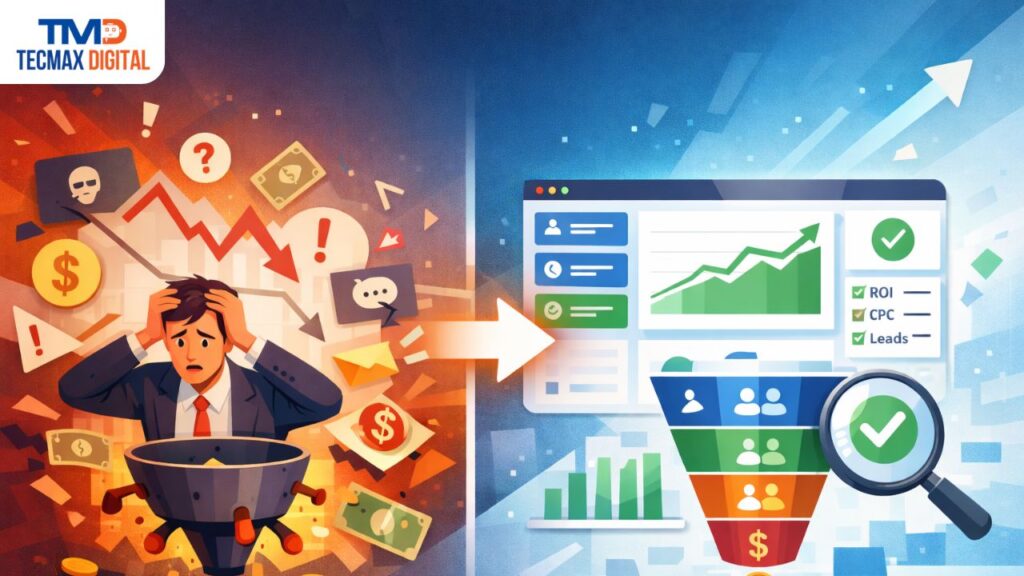
Last month, I spoke with a business owner who believed he had done everything right. He had invested over $5,000 into ads, content, and an agency that he hired. Campaigns were active, content was consistent, and the effort was there. He was doing everything that a person with decent knowledge of marketing could’ve done.
But the results told a different story.
Despite all that effort, just 11 leads came through, and only 2 converted into paying customers. There was no clear explanation. No way to tell which channel worked, where the problem was, or what needed to change. A professional digital marketing audit service is exactly what a business owner needs in that situation.
What Is a Digital Marketing Audit?
A digital marketing audit is a detailed review of all your online marketing activities that includes, posting on social media, sending emails, running ads, and everything else you’re doing. It helps you understand what is generating results, which channels are underperforming, where money is being wasted, and what needs improvement first.
It answers one question: which parts of my marketing are actually contributing to revenue?
And trust me, many businesses I know don’t have a clear answer to that question.
Why Digital Marketing Audit Services Matter in 2026
When you’re only doing one thing like SEO or paid ads, tracking results is easy. But once you’re running SEO, ads, social media, content, and email together, it gets harder to keep track of what’s actually working.
Many businesses stay active across platforms, but being active everywhere doesn’t guarantee results. It’s a lesson that most people learn the hard way.
A proper audit removes all the guesswork. It helps you focus on channels that bring returns, fix issues that cost you conversions, and align your efforts with business goals.
Without the audit, you usually end up spending more on the same things again and again without knowing if they’re working or not.
Signs You Need a Digital Marketing Audit
You should consider a marketing audit if any of these signs feels relatable to you:
| Your website traffic is increasing, but leads are not | Visitors leave your site quickly |
| You rank higher than your competitors but still no traffic | Your bounce rate is higher than 80% |
| You are running ads but don’t know your cost-per-lead | You have no clear call-to-action |
| You don’t know which channel brings paying customers | You rely only on paid marketing |
| Your marketing results feel inconsistent | Competitors get more business with less effort |
| You are investing more than you’re getting back | You feel something is wrong but don’t know what |
| You get inquiries, but most are irrelevant | You make decisions without data |
| People contact you but don’t convert | You don’t track leads properly |
| You get ad clicks, but no conversions | You depend fully on a freelancer/employee |
| You ran ads but don’t know what worked | You get leads but don’t close them |
| Your website looks good but lacks clarity | Your Google Business profile brings no results |
| You post regularly but get no business | Customers still ask basic questions after visiting your site |
| You depend on one source for customers | You are active everywhere but strong nowhere |
| You tried multiple channels with no results |

All of these point to the same problem, you don’t have a clear picture of what your marketing is actually doing. That’s when it starts to feel like money is being wasted.
What Does a Digital Marketing Audit Service Include?
A complete digital marketing audit looks at each major channel and how they work together.
1. Tracking and Analytics
Before anything else, you need to know whether your data can actually be trusted. If your tracking is broken or misconfigured, every decision you make on top of it is built on shaky ground.
A tracking audit covers:
- GA4 setup: whether it’s properly configured and used correctly
- Conversion tracking accuracy: are the right actions being counted as conversions?
- Duplicate conversions: are the same events being counted more than once?
- Bot traffic: non-human traffic inflating your numbers
- Spam referral traffic: junk sources distorting your referral data
- UTM consistency: whether your campaign links are tagged correctly and consistently
- Pixel tracking: Meta and Google Ads pixels firing on the right pages
- Cross-domain tracking: whether sessions are breaking when users move between domains
- Data mismatches between GA4 and Ads: when the numbers in your ad platform don’t match what GA4 shows, something is wrong
Most businesses skip this step because it sounds too technical. The result is that they optimize campaigns using data they can’t actually rely on.
2. Website Audit (Technical Performance and Conversion)
Your website is the place where marketing turns into actual business.
The audit includes:
- Core Web Vitals and page speed: slow pages lose visitors before they read a word
- Mobile responsiveness: how the site performs and feels on a phone
- Broken links: internal or external links pointing to pages that no longer exist
- 404 errors: pages returning errors instead of content
- Redirect issues: chains, loops, or broken redirects that confuse both users and search engines
- Indexing issues: pages that should be ranking but aren’t being picked up by Google
- Duplicate content: the same content appearing on multiple URLs
- Sitemap and robots.txt: whether these files are set up correctly and not blocking the wrong pages
- User experience and conversion paths: forms, CTAs, and contact flows that work properly
Even small usability issues can reduce conversions more than you’d expect.
3. SEO Audit (Search Visibility and Rankings)
An SEO audit shows how your website performs in search engines like Google.
An SEO audit includes:
- Meta title optimisation: whether your page titles and descriptions are doing their job
- Keyword targeting accuracy: are you ranking for searches that actually bring customers?
- Keyword cannibalization: multiple pages competing for the same keyword and hurting each other’s rankings
- Internal linking: how pages on your site connect and pass authority to each other
- Backlink quality: whether the sites linking to you are helping or doing nothing
- Toxic backlinks: low-quality or spammy links that can actively harm your rankings
- Local SEO and Google Business Profile: particularly important if you serve a specific area
- Reviews and ratings: your reputation signals across Google and other platforms
If you’re not ranking for “your service + your city,” your visibility is limited.
4. Paid Ads Audit (ROI and Efficiency)
This focuses on platforms like Google Ads and Meta Ads.
Paid Ads audit includes:
- Campaign structure: how your campaigns, ad groups, and ads are organised
- Budget allocation: whether spend is going to the right campaigns
- Keyword match types: whether you’re casting too wide a net or too narrow
- CTR performance: how often people click when they see your ad
- Conversion rate: what happens after the click
- Click fraud and bot clicks: invalid traffic eating into your budget
- Audience targeting: whether you’re reaching the right people
- Retargeting setup: whether past visitors are being followed up with correctly
Most ad budgets aren’t wasted in big mistakes. It usually happens through small inefficiencies that build up over time.
5. Lead Quality and Funnel
Getting leads is only useful if those leads are real and actually converted. This part of the audit looks beyond raw lead numbers.
The audit includes:
- Lead quality: the ratio of genuine enquiries to junk submissions
- Fake leads and spam: form submissions that clog your CRM and skew your data
- Bot form submissions: automated submissions that look like leads but aren’t
- Lead-to-sale conversion rate: how many leads actually become customers
- Response time: how quickly leads are being followed up (this matters more than most businesses realise)
- Funnel drop-off: where in the process people are falling away
A business could be generating 50 leads a month and still struggling if 40 of them are low-quality or being followed up too slowly.
6. Conversion Rate Optimisation (CRO)
This looks at what’s stopping people from taking action once they’re on your site.
The CRO audit covers:
- CTA clarity: whether your calls to action are obvious and compelling
- Form usability: whether your forms are simple enough that people actually complete them
- UX friction points: steps in the process that cause unnecessary drop-off
- Mobile conversion issues: problems that specifically affect users on phones
- Exit rate pages: pages where people are leaving without doing anything
Traffic without conversion is just an expense.
7. Content Audit (Relevance and Performance)
A content audit checks whether your content actually helps your audience and supports your business.
The Content audit includes:
- User intent match: does your content answer what people were actually searching for?
- Content depth: is it thorough enough to be genuinely useful?
- Content gaps: topics your audience cares about that you haven’t covered
- Outdated content: pages with old information that could be hurting trust or rankings
- Blog to service linking: whether your blog content is actively pointing readers toward your services
Content shouldn’t just attract attention. It should help people make decisions.
8. Social Media Audit (Performance vs Activity)
A social media audit shows the difference between being active and actually getting results.
Social Media audit includes:
- Engagement rate: how people respond to your content, not just how many followers you have
- Follower quality: whether your audience is made up of real, relevant people
- Content consistency: whether you’re showing up regularly enough to stay visible
- Platform relevance: whether the platforms you’re on are actually where your customers spend time
Not every platform contributes equally to business growth. Some are worth your time. Some are just habits.
9. Business Reality Check
It’s the last part in an audit that ties everything together. It looks at whether your marketing is connected to actual business outcomes.
It covers:
- Traffic vs revenue alignment: are the people visiting your site the ones who actually buy?
- Cost per customer: what does it actually cost to acquire one paying customer?
- Channel ROI: which channels are generating real returns and which are just generating activity?
- Vanity metrics dependency: are decisions being made based on follower counts and impressions rather than revenue and leads?
This is where many audits reveal the most surprising truths. Businesses that feel like their marketing is working often find that one or two channels are doing all the heavy lifting while the rest just waste the money.
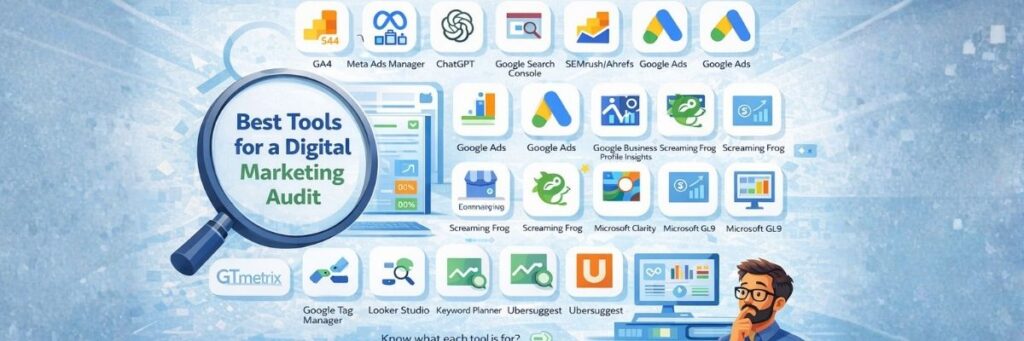
Best Tools for a Digital Marketing Audit
You can start with these tools:
- Google Analytics 4: Traffic, user behavior, conversions
- Google Search Console: Search performance, indexing, keywords
- Google Tag Manager: Tracking setup and event accuracy
- Google Ads Dashboard: Ad performance, cost, conversions
- Meta Ads Manager: Campaign performance, audience response
- Google PageSpeed Insights: Page speed and core web vitals
- GTmetrix: Load time and technical performance issues
- SEMrush / Ahrefs: SEO audit, backlinks, keyword gaps
- Ubersuggest: Keyword ideas and basic SEO insights
- Screaming Frog: Technical SEO issues, site crawl
- Microsoft Clarity: User behavior, heatmaps, recordings
- Google Business Profile Insights: Local visibility, calls, actions
- Looker Studio: Data reporting and visualization
- Keyword Planner: Keyword volume and competition
- Bing Webmaster Tools: SEO performance on Bing
- ChatGPT/Perplexity/Claude: Content generation & gaps, research, messaging clarity, ideas
Tools give you data, but if you don’t know what to do with it, it won’t get you far.
Can You Do a Digital Marketing Audit Yourself?
Yes, you can run a basic audit using free tools.
This helps you:
- Spot obvious issues
- Understand your data
- Get a clearer view of your marketing system
You can catch some problems on your own. But without experience, you’re likely to miss the issues that actually impact results. That’s where professional digital marketing audit service make the difference.
When Should You Do a Marketing Audit?
You should run a digital marketing audit:
- Before increasing your marketing budget
- When results suddenly drop
- Before launching a new campaign or product
- When you’re unsure what’s working
Regular audits help keep your strategy aligned with real results.
Why Are Most Businesses Struggling?
They’re making decisions without reliable data. An audit replaces assumptions with actual insights that contain facts and stats. It shows you what’s working so you can do more of it, and what isn’t so you can stop spending money on it. If you’re already investing in marketing, the next thing to do is understand where that investment is actually going.
FAQs
- What is included in digital marketing audit services?
A digital marketing audit includes tracking and analytics review, website technical analysis, SEO performance, content evaluation, paid ads review, lead quality assessment, conversion optimization, social media performance, and a business-level review of what’s actually driving revenue. - How much does a digital marketing audit cost?
Costs typically range from $1,000 to $5,000 depending on the depth and scope. - How long does a marketing audit take?
A basic audit may take a few hours, while a full professional audit usually takes 1 to 2 weeks. - Is a digital marketing audit worth it?
Yes. It helps identify wasted spend, improve ROI, and gives you a clearer direction for your marketing.