
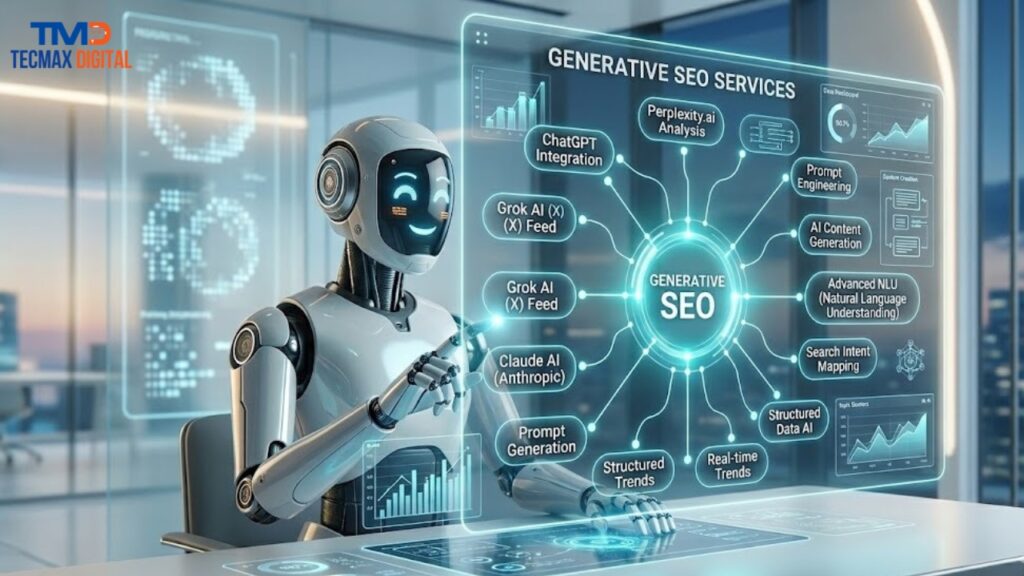
A client called me last month. Frustrated. Confused.
“Our rankings haven’t dropped. We’re still on page one. But leads are drying up.”
I checked their analytics. Traffic down 34% with no change in rankings. And then it clicked.
People weren’t clicking anymore. They were getting answers directly from ChatGPT, Google’s AI Overviews and Perplexity.
Their content was ranking. But it wasn’t being cited.
That’s the new game. And most businesses don’t even know they’re losing it.
What Generative SEO Actually Means
Forget everything you know about SEO for a second.
Traditional SEO asks: “How do I rank higher?”
Generative SEO asks: “How do I become the answer?”
Big difference, right?
AI systems don’t just crawl your site, they interpret it. They decide if your brand is trustworthy enough to quote. They look for entities, context and structure, not just keywords.
If your content isn’t built for AI comprehension, you’re invisible in the places where people are increasingly looking.
Why This Matters Right Now
Here’s what’s happening now, users type a question into ChatGPT or Perplexity. They get a direct answer. Maybe a few sources cited at the bottom. Which means they don’t need to visit your website anymore.
Research from Princeton and IIT Delhi confirms what I’ve been seeing recently that AI systems prioritize well-defined entities, structured content, and high-authority sources.
Ranking first on Google used to mean everything. But now? It might mean nothing if the AI doesn’t trust you enough to cite you.
Does Your Business Have a Generative SEO Problem?
Check if this sounds like you:
- Your Google rankings are stable, but website traffic is declining
- You rank on page one, but you’re not sure if you appear in ChatGPT or Perplexity results
- You’ve never checked whether AI systems are citing your content
- You’re getting impressions in Google Search Console but fewer clicks
If two or more of these apply, you likely have a generative SEO visibility gap.
The Six Pillars of Generative SEO
Let me break down what a solid generative SEO strategy actually includes:
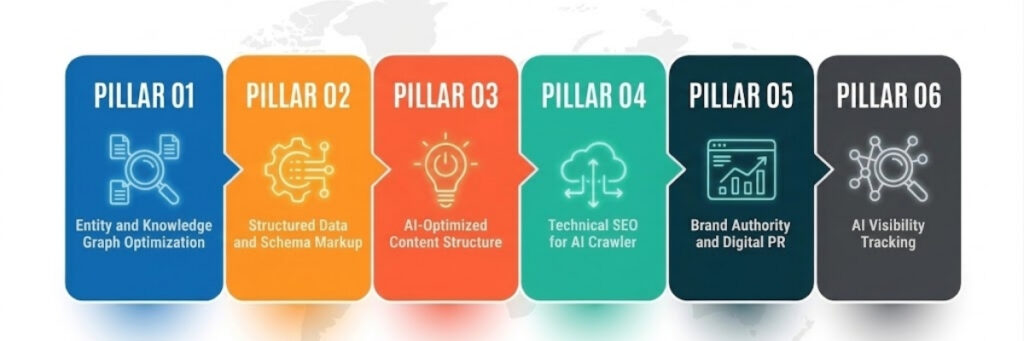
1. Entity and Knowledge Graph Optimization
AI doesn’t read your content the way humans do, it identifies relationships. Your brand, founders, and your services. How they connect to broader concepts.
If your entity presence is weak or inconsistent across the web, AI systems will struggle to trust you. Platforms like Wikipedia often serve as reference points, which is why external validation matters more than ever.
2. Structured Data and Schema Markup
Think of schema markup as a translation layer. You’re telling AI exactly what your content means, not hoping it figures it out.
Using Schema.org frameworks, you can define your services, FAQs, articles, and organization details. This improves your chances of appearing in rich results and AI-generated summaries.
3. AI-Optimized Content Structure
AI models love clarity. Short paragraphs. Descriptive headings. Direct answers to direct questions.
If your content rambles or buries key information, it gets skipped. Not penalized, just ignored. which is worse in my opinion.
4. Technical SEO for AI Crawlers
Here’s something most people miss. AI systems use their own crawlers. GPTBot, PerplexityBot, and others.
If your robots.txt blocks them, your content doesn’t exist to AI. Your website should have faster load times, cleaner HTML codes and proper crawl permissions, these aren’t optional anymore.
5. Brand Authority and Digital PR
AI doesn’t just look at your website. It evaluates your presence across the entire web.
Are you mentioned on authoritative sites? Do credible sources reference your expertise? This affects whether AI treats you as a trustworthy source.
6. AI Visibility Tracking
Google Analytics won’t help you here. You need new metrics. AI citations, Query-based visibility and Competitor benchmarking in AI responses.
Remember one thing, without tracking, you’re optimizing blind.
A Real Example
I worked with a B2B SaaS company earlier this year. Mid-sized. Good product. Decent traffic.
But they weren’t showing up in AI answers. Their competitors were.
We restructured their content around entities instead of keywords. Deployed schema markup on their core pages. Built authority through strategic placements on high-trust platforms.
Three months later, they started appearing in AI-generated summaries. Organic engagement improved, even though raw click numbers stayed flat.
That’s the shift. Success isn’t just traffic anymore. It’s the influence that counts.
Who Needs This?
If you’re in SaaS, e-commerce, healthcare, finance, or education, you’re in a high-adoption zone. These industries are already seeing the effects.
But here’s a simpler test.
Search for your core service in ChatGPT or Perplexity. Does your brand come up? Do your competitors?
If they’re there and you’re not, you have a problem.
What Most Agencies Won’t Tell You
Ranking number one doesn’t guarantee AI visibility. Backlinks alone won’t save you. Unstructured content often gets completely ignored by crawlers.
I’ve seen businesses with strong traditional SEO profiles get zero AI citations. And I’ve seen smaller players with sharp, entity-optimized content punch way above their weight.
This isn’t an upgrade to your existing strategy. It’s a different game.
Choosing the Right Provider
Not every SEO agency understands this space. Most are still focused on rankings and backlinks.
Ask these questions:
- Do you optimize specifically for AI crawlers like GPTBot?
- How do you measure AI visibility, not just search rankings?
- Can you show me real examples of AI citations you’ve generated?
If they stumble on these, keep looking.
A credible provider should deliver entity optimization, structured data implementation, content restructuring, and ongoing AI performance tracking. Not vague promises about “future-proofing” your SEO.
Watch out for agencies that only talk about traditional metrics. Or ones that can’t explain how AI visibility differs from search visibility.

What This Costs
Pricing depends on your scale and complexity. Here’s a rough breakdown:
- Basic optimization runs $500 to $700+ per month which is Good for foundational work.
- A full growth strategy sits between $1,000 and $1,800+. This covers entity mapping, schema deployment, content restructuring, and tracking.
- Enterprise-level engagements start at $5,000+ and go up from there. Think large sites, multiple products, aggressive AI visibility goals.
- Factors that affect cost: website size, industry competition, content volume, and how much technical debt you’re carrying.
- Hidden costs to watch for: large-scale content rewrites, technical fixes that weren’t scoped upfront, and authority-building campaigns that take time to pay off.
Explore Tecmaxdigital’s Generative Engine Optimization Services
Can You Do This Yourself?
Some of it, Yes.
Basic content formatting, simple schema markup, blog optimization, you can handle these in-house if you have the bandwidth.
But entity mapping? Knowledge graph optimization? AI visibility tracking? Advanced technical SEO?
That’s where expertise matters. Not because it’s impossible to learn. But because the cost of doing it wrong is invisibility.
How Long Before You See Results?
- Expect AI systems to crawl and index your changes within 30 to 60 days.
- Initial AI citations typically appear around the 3 to 6 month mark.
- Strong, consistent visibility? That’s a 6-month-plus commitment.
- This isn’t a quick fix. It’s a compounding asset. The earlier you start, the harder it becomes for competitors to catch up.
The Bottom Line
Search is splitting in two.
There’s still the old world of rankings and clicks. That’s not going away.
But there’s a new world forming alongside it. One where AI decides who gets cited, who gets trusted, and who will become the answer?
Most businesses are optimizing for a game that’s already changing beneath their feet.
The question isn’t whether generative engine optimzation matters, It’s whether you’ll figure it out before your competitors do.
FAQs
- Why am I losing traffic even though my rankings haven’t dropped?
Because people aren’t clicking like they used to. They’re getting answers directly from AI tools like ChatGPT and Google AI Overviews. If your content isn’t being cited there, you lose visibility even if you’re still ranking. - What does it mean to “become the answer” in SEO?
It means your content is clear and trustworthy enough for AI systems to quote directly. Instead of just appearing in search results, your content gets used inside the answer itself. - How is generative SEO actually different from traditional SEO?
Traditional SEO is about rankings and traffic. Generative SEO is about being understood and trusted by AI systems. If AI can’t interpret your content properly, it won’t use it, no matter where you rank. - Why isn’t my content showing up in ChatGPT or Perplexity results?
Most likely, your content isn’t structured in a way AI can easily interpret. Weak entity signals, lack of schema, or poor content clarity can all make your content invisible to AI systems. - Do backlinks still matter in generative SEO?
Yes, but not in the same way. It’s not just about quantity anymore. AI looks at where you’re mentioned and whether those sources are credible enough to trust you. - What’s the biggest mistake businesses make with generative SEO?
Assuming their existing SEO strategy is enough. Many businesses are still optimizing for rankings while completely ignoring how AI systems evaluate and select content. - How do I know if my brand is visible in AI search?
Search your main service in tools like ChatGPT or Perplexity. If competitors are mentioned and you’re not, that’s a clear signal you’re missing from AI visibility. - Is generative SEO only for big companies?
Not at all. In fact, smaller brands can benefit more. AI systems care more about clarity and authority than brand size, which creates opportunities to compete with bigger players. - Can I handle generative SEO myself, or do I need an expert?
You can handle the basics, like formatting and simple schema. But deeper work like entity mapping, knowledge graph optimization, and AI tracking usually requires experience. - How long does it realistically take to see results?
You might see early signs in a couple of months, but meaningful visibility in AI answers usually takes 3 to 6 months. Strong results build over time. - What should I expect from a good generative SEO service provider?
Clear deliverables. Not vague promises. They should talk about entity optimization, structured data, AI visibility tracking, and show proof of actual AI citations. - Is generative SEO replacing traditional SEO completely?
No. Traditional SEO still matters. But if you ignore generative SEO, you’re missing where a growing share of search behavior is moving.