
Right now, someone’s asking ChatGPT for the solution you provide. Your competitor shows up in the answer. You don’t. They get the client. You get nothing.
This isn’t a Google ranking problem. Your content could rank #1 on Google and still be invisible to ChatGPT, Perplexity, and voice search. That’s the gap. That’s where you’re losing customers without even knowing it.
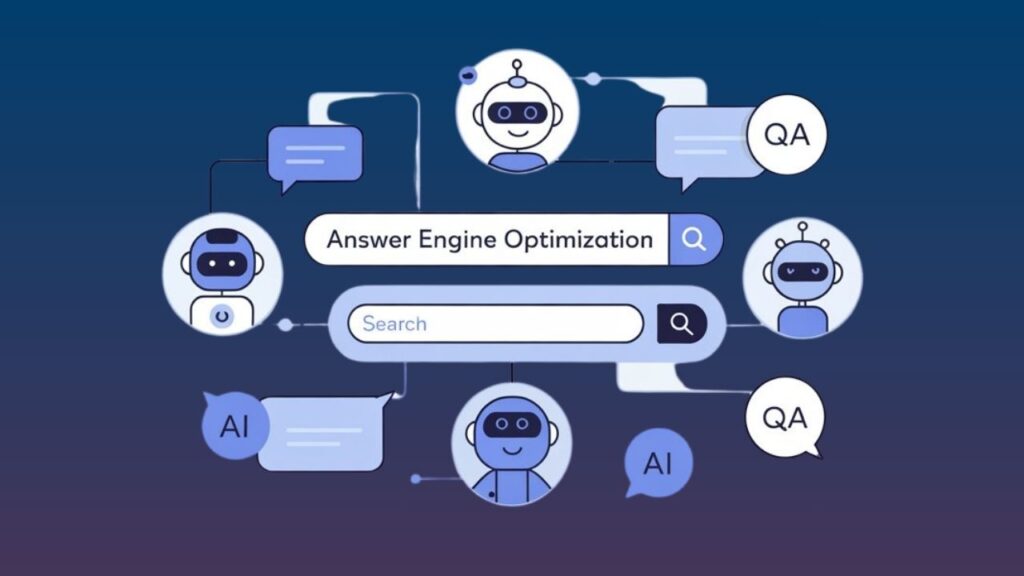
Answer Engine Optimization (AEO) fixes this. It’s the strategy that gets your content cited inside AI search results, not just ranking for keywords. When ChatGPT recommends you, when Perplexity pulls your answer, when voice search returns your solution, that’s AEO working. This guide shows you exactly how to make it happen.
What is Answer Engine Optimization (AEO)?
Answer Engine Optimization (AEO) is a relatively new but rapidly evolving branch of digital marketing. It focuses on optimizing content to provide direct and concise answers to user queries.
Unlike traditional Search Engine Optimization (SEO) that relies heavily on keywords, AEO prioritizes the context and intent behind those keywords. The ultimate goal is to appear in answer boxes, rich snippets, and other special features that search engines offer for quick information retrieval.
This strategy is becoming increasingly vital as more users turn to voice-activated assistants like Siri, Alexa, and Google Assistant, which are designed to provide immediate answers rather than direct users to a series of web links.
The rise of AEO is largely a response to changing user behaviors. People no longer just type keywords into a search bar; they ask complex questions and expect precise, actionable answers. Think about how often you ask your voice assistant a specific question, such as “How do you make lasagna?” or “What’s the weather like today?”
The answers you receive are often brief but packed with the information you need, and this is where AEO excels. It’s about meeting users’ needs quickly and effectively, making your content not just discoverable but immediately valuable.
Moreover, AEO is not limited to voice search alone. It also caters to text-based searches where users still seek direct answers.
This means that businesses can leverage AEO to gain visibility across multiple platforms, including traditional search engines and voice search technologies.
By focusing on answering questions accurately and succinctly, AEO helps businesses establish themselves as authoritative sources in their respective fields, fostering trust and engagement with their audience.

The Importance of Online Visibility in 2026
In the digital age, online visibility is paramount for any business aiming to thrive. With millions of websites competing for attention, being easily discoverable can significantly affect your brand’s success.
High visibility ensures that your target audience can find you quickly, leading to increased web traffic, higher conversion rates, and ultimately, greater revenue. The more visible you are online, the more opportunities you have to engage with potential customers and build lasting relationships.
Online visibility also plays a crucial role in brand credibility. When your business consistently appears in top search results, users are more likely to perceive you as a trusted authority in your industry.
This credibility can be further enhanced through customer reviews, social proof, and high-quality content that addresses the needs and concerns of your audience. As users become more discerning about the information they consume, being visible and credible can set you apart from competitors.
Furthermore, with the rise of mobile and voice search, online visibility is no longer confined to traditional search engines. Users expect to find information quickly and easily across various devices and platforms. This shift underscores the need for a comprehensive digital strategy that includes AEO.
By optimizing your content to answer user queries effectively, you can ensure that your business remains visible and relevant in an increasingly competitive digital landscape.
What is the Differences Between Traditional SEO and Answer Engine Optimization (AEO)?
While traditional SEO and AEO share the common goal of improving online visibility, they differ significantly in their approaches and focus areas.
Traditional SEO primarily revolves around optimizing web pages for specific keywords to rank higher in search engine results pages (SERPs). This involves on-page elements like meta tags, headings, and content, as well as off-page factors such as backlinks and domain authority.
The success of traditional SEO is often measured by an increase in organic traffic and higher rankings for targeted keywords.
AEO, on the other hand, shifts the focus from keywords to user intent. It aims to provide concise and accurate answers to the questions users are asking.
Instead of optimizing solely for search engines, AEO optimizes for answer engines, which include voice assistants and search features like Google’s Featured Snippets. This requires a deeper understanding of the context behind user queries and the creation of content that directly addresses those queries.
AEO is more about delivering immediate value to the user than driving traffic to a website.
Another key difference lies in the metrics for success. While traditional SEO looks at metrics such as organic traffic, bounce rates, and click-through rates, AEO focuses on user engagement and satisfaction.
This includes metrics like the number of times your content appears in answer boxes, the accuracy of the answers provided, and user feedback.
By prioritizing user experience, AEO aligns more closely with the evolving behaviors and expectations of online consumers, making it a critical component of modern digital marketing strategies.

How Answer Engine Optimization (AEO) Works: The Mechanisms Behind Answer Engines
Answer engines operate on sophisticated algorithms designed to understand and interpret natural language queries. These algorithms analyze the context, semantics, and intent behind a user’s question to deliver the most relevant and accurate answers.
This process involves several steps, starting with keyword analysis and extending to the extraction of pertinent information from vast data sources. The goal is to match the user’s query with the best possible answer available, often presented in the form of rich snippets, knowledge graphs, or direct answers.
One of the primary mechanisms behind answer engines is natural language processing (NLP). NLP enables answer engines to comprehend complex queries and nuances in human language. By breaking down a query into its core components, NLP helps the engine understand the user’s intent and context.
This is particularly important for voice searches, which tend to be more conversational and varied than text-based searches. For instance, a user might ask, “What’s the best way to reduce fever in children?” rather than simply typing “reduce fever in children.” NLP ensures that the answer engine can interpret the full question and provide a precise response.
Machine learning also plays a crucial role in the functionality of answer engines. Through continuous learning and refinement, these engines improve their ability to deliver accurate answers over time. Machine learning models analyze user interactions, feedback, and satisfaction levels to fine-tune their algorithms.
This iterative process helps answer engines become more adept at understanding diverse queries and delivering high-quality answers. As a result, businesses that leverage AEO can benefit from increasingly accurate and contextually relevant content delivery, enhancing their online visibility and user engagement.
Benefits of Utilizing AEO Services for Your Business
Utilizing Answer Engine Optimization services can offer a multitude of benefits for businesses seeking to enhance their online presence and connect with their target audience more effectively.
One of the most significant advantages is improved visibility in search results. By optimizing content to answer specific user queries, businesses can increase their chances of appearing in featured snippets, knowledge panels, and other high-visibility areas of search results.
This not only drives more traffic to their websites but also positions them as authoritative sources of information.
Another key benefit is enhanced user experience. AEO focuses on providing direct and accurate answers to user queries, which helps meet users’ needs quickly and efficiently.
This can lead to higher user satisfaction and engagement, as users are more likely to return to a website that consistently provides valuable and relevant information.
Additionally, a positive user experience can result in higher conversion rates, as satisfied users are more likely to take desired actions, such as making a purchase or signing up for a newsletter.
AEO also offers a competitive edge in an increasingly saturated digital landscape. As more businesses recognize the importance of voice search and advanced query capabilities, those that adopt AEO early on can gain a significant advantage over their competitors.
By prioritizing user intent and delivering high-quality answers, businesses can differentiate themselves and build stronger connections with their audience. This can lead to increased brand loyalty, repeat business, and positive word-of-mouth referrals, further enhancing their online visibility and overall success.

Identifying Your Target Audience for Effective AEO
Identifying your target audience is a critical step in implementing effective AEO strategies. To create content that answers user queries, you first need to understand who your audience is, what they are searching for, and how they are asking their questions.
This involves conducting thorough audience research to gather insights into their demographics, preferences, behaviors, and pain points. By understanding your audience’s needs and motivations, you can tailor your content to provide the most relevant and valuable answers.
One effective way to identify your target audience is by analyzing search data and user behavior. Tools like Google Analytics, Google Search Console, and other SEO platforms can provide valuable insights into the types of queries users are making and how they interact with your website.
This data can help you identify common questions, trending topics, and areas where users may need more information. By leveraging this data, you can create content that addresses these specific queries and meets the needs of your audience.
Another important aspect of identifying your target audience is understanding the context in which they are searching. This includes considering factors such as the device they are using, their location, and the time of day they are searching. For example, mobile users may be looking for quick, on-the-go answers, while desktop users may be conducting more in-depth research.
By understanding the context of your audience’s searches, you can optimize your content to provide the most relevant and useful answers, enhancing your AEO efforts and improving your online visibility.
Crafting Content That Answers User Queries
Crafting content that effectively answers user queries is at the heart of AEO.
To achieve this, you must focus on creating high-quality, informative, and engaging content that addresses the specific questions and needs of your audience. This involves conducting thorough keyword research to identify common queries and developing content that provides clear, concise, and accurate answers.
The goal is to create content that not only ranks well in search results but also meets the expectations of users seeking quick and reliable information.
One effective strategy for crafting answer-focused content is to use the “inverted pyramid” approach. This involves starting with the most important information at the beginning of your content and gradually providing more detailed information as you go.
By front-loading your content with the key answer, you ensure that users receive the information they need right away, which can improve their satisfaction and engagement. This approach is particularly useful for voice searches, where users often seek immediate and concise answers.
In addition to structuring your content effectively, it’s important to use clear and concise language that is easy to understand. Avoid jargon and complex terminology that may confuse users, and instead, focus on providing straightforward and actionable information.
Using bullet points, headings, and other formatting techniques can also help break up your content and make it more scannable. By prioritizing clarity and readability, you can create content that effectively answers user queries and enhances your AEO efforts.

Tools and Techniques for Implementing AEO
Implementing AEO requires a combination of the right tools and techniques to optimize your content and improve your online visibility. One essential tool for AEO is keyword research software, such as Ahrefs, SEMrush, or Moz.
These tools can help you identify the questions and queries your target audience is asking and provide insights into the search volume and competition for those queries. By understanding the specific questions users are searching for, you can create content that directly addresses their needs.
Another important tool for AEO is structured data markup, also known as schema markup. This is a type of code that you can add to your website to help search engines understand the content and context of your pages. Structured data can enhance your chances of appearing in rich snippets, knowledge panels, and other high-visibility areas of search results.
Tools like Google’s Structured Data Markup Helper can assist you in implementing schema markup on your website, making it easier for search engines to index and display your content.
In addition to these tools, there are several techniques you can use to enhance your AEO efforts. One effective technique is to create content that is specifically designed to answer common questions. This can include FAQ pages, how-to guides, and blog posts that provide detailed and accurate answers to user queries.
You can also use internal linking to connect related content on your website, making it easier for users and search engines to find and navigate your content. By leveraging these tools and techniques, you can improve your AEO efforts and boost your online visibility.
Case Studies: Success Stories of AEO Implementation
To illustrate the effectiveness of Answer Engine Optimization services, let’s explore some success stories of businesses that have implemented these strategies and achieved significant results.
One notable example is a leading e-commerce company that optimized its product pages for common user queries. By conducting thorough keyword research and implementing structured data markup, the company was able to appear in rich snippets and answer boxes for key product-related queries. This resulted in a significant increase in organic traffic, higher conversion rates, and improved user engagement.
Another success story comes from a health and wellness website that focused on creating content to answer specific health-related questions. By developing detailed and informative articles on common health topics and using clear and concise language, the website was able to rank highly in search results for key queries.
The implementation of AEO strategies not only boosted the website’s visibility but also established it as a trusted source of health information, leading to increased user trust and credibility.
A third example involves a financial services company that optimized its blog content for AEO. By identifying common questions related to financial planning and investment and creating content that provided clear and actionable answers, the company was able to achieve high rankings in search results.
The use of structured data markup further enhanced the company’s visibility in answer boxes and knowledge panels. As a result, the company saw a significant increase in website traffic, higher user engagement, and more leads generated through its online content.
Future Trends in AEO and Online Visibility Strategies
As the digital landscape continues to evolve, so too will the strategies for AEO and online visibility. One emerging trend is the increasing importance of voice search.
With the growing adoption of voice-activated assistants and smart devices, more users are conducting searches through voice commands. This shift underscores the need for businesses to optimize their content for voice search by focusing on natural language queries and providing concise and accurate answers.
Another trend to watch is the rise of artificial intelligence (AI) and machine learning in search algorithms. Search engines are becoming more sophisticated in understanding user intent and delivering relevant results.
This means that businesses will need to prioritize high-quality, user-focused content that addresses the specific needs and queries of their audience. AI-driven tools and technologies will also play a greater role in helping businesses identify and optimize for common user queries.
Finally, the integration of AEO with other digital marketing strategies will become increasingly important. As users’ expectations for quick and accurate information continue to rise, businesses will need to adopt a holistic approach that combines AEO with traditional SEO, content marketing, and social media.
By leveraging multiple channels and strategies, businesses can enhance their online visibility, reach a broader audience, and build stronger connections with their customers. Embracing these future trends and staying ahead of the curve will be key to unlocking success in the ever-changing digital landscape.